


Your Ultimate Guide to Flat Bed Sheets in NZ
A flat sheet is simply that large, rectangular piece of fabric that goes between you and your duvet or blanket. It’s separate from the fitted sheet, which has elasticated corners to hug your mattress. While it might seem like an old-fashioned extra, a flat sheet is one of the most important parts of a well-made, comfortable, and hygienic bed.
Why Flat Sheets Still Belong on Your Bed
People often ask if they really need a flat sheet, especially if they’re already using a duvet cover. The short answer? Absolutely. Think of it this way: your fitted sheet protects your mattress, but the flat sheet is the hardworking layer that perfects your entire sleep setup. It's the secret to a bed that feels cleaner, more comfortable, and looks effortlessly stylish.
Let’s move past the idea that it’s just an outdated tradition. The modern flat sheet is a game-changer. It acts as a protective barrier between you and your duvet cover, absorbing the natural oils and perspiration your body releases overnight. This means you only need to wash the lightweight flat sheet each week, while your heavier, often more expensive duvet cover can go much longer between washes. It’s a simple change that saves you time and effort, and it will dramatically extend the life of your beautiful duvet.
The Pillars of a Perfect Bed
The benefits go far beyond just cleanliness. A flat sheet adds a layer of versatility and comfort that makes it essential for any season.
-
Better Temperature Control: During those warm New Zealand summer nights, a heavy duvet is often too much. A light, breathable flat sheet in a material like Supima® cotton or our airo-washed linen provides just the right amount of coverage without trapping heat, helping you sleep cooler. Come winter, it creates an extra pocket of air, adding a surprising amount of insulation and warmth without the bulk.
-
Unbeatable Comfort and Feel: There's nothing quite like the feeling of slipping under a crisp, clean flat sheet. It provides a smooth, soft surface against your skin that’s often much nicer than the texture of a duvet cover alone. It’s that simple touch of luxury that ensures what’s touching you is always fresh and inviting.
A flat sheet isn’t just another piece of linen; it’s a deliberate choice for a more hygienic, versatile, and luxurious sleep. It’s what turns your bed from a place you just sleep into a thoughtfully designed sanctuary.
Ultimately, using a flat sheet is about elevating your entire sleep experience. It's the practical solution for keeping your bedding pristine, the flexible answer to year-round comfort, and the elegant touch that helps create that polished, hotel-style look. This single piece of fabric is fundamental to building a bed that is not just beautiful, but also intelligently designed for the best possible rest.
Finding the Perfect Fit for New Zealand Beds
You'd think choosing the right size flat sheet would be as simple as matching the label to your bed size, right? But if you’ve ever wondered how boutique hotels get that perfect, inviting drape, there’s a little more to it. It’s not just about covering the mattress; it's about having enough fabric to tuck in tightly and hang beautifully.
This is particularly true here in New Zealand, where our local bed and linen sizes don't always line up with what you’d find overseas. Getting it right means avoiding that all-too-common frustration of a sheet that’s too short to tuck, or one that puddles on the floor. A perfectly sized flat sheet truly is the foundation of a beautifully made bed.
Why Mattress Depth is the Secret Ingredient
The one thing most people forget to consider when buying flat sheets? Mattress depth. Modern mattresses, especially those with plush pillow tops or extra comfort layers, are much deeper than they used to be. A standard flat sheet might just skim the surface, leaving you with nothing to create that secure, crisp tuck.
To make sure you get a perfect fit every time, a quick measure of your mattress is all it takes.
- Measure the Width (W): Simply run a tape measure from one side of your mattress to the other.
- Measure the Length (L): Measure from the head of the mattress right down to the foot.
- Measure the Depth (D): This is the game-changer. Measure from the very bottom edge of the mattress to its highest point on top.
With these numbers in hand, you can figure out the ideal dimensions for your flat sheet. You need enough fabric to cover the top, both sides, and still have plenty left over to tuck under. The same goes for the length—enough to cover the mattress and leave a generous amount to secure at the foot.
This simple decision-making flowchart helps clarify why a flat sheet is an essential part of any bedding collection, touching on hygiene, comfort, and style.
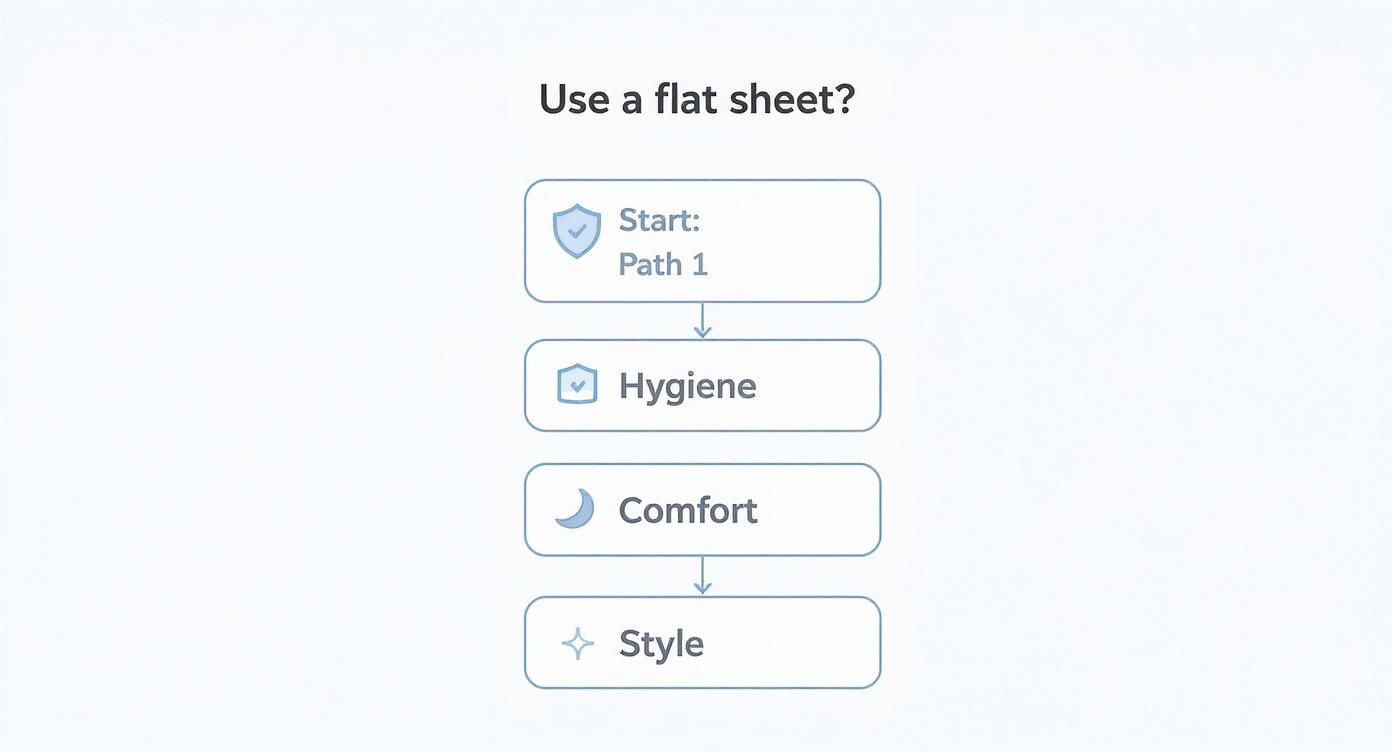
As the flowchart shows, using a flat sheet isn't just about tradition; it's driven by practical benefits that make for a better sleep environment.
Navigating New Zealand Bedding Sizes
Getting familiar with our local standards is the key to shopping with confidence. In New Zealand, flat sheets are made to specific sizes that often differ from other countries. For instance, a standard Queen flat sheet here is typically 245 cm x 275 cm, while a King is around 275 cm x 275 cm. These dimensions are designed to give you that generous overhang for both aesthetic appeal and a comfortable, secure tuck. You can explore a complete breakdown of New Zealand sheet sizes in our detailed guide.
When you compare these to international sizes, you quickly see why you can't always buy based on the name alone. A "King" in the US is a completely different beast to a "King" here.
Choosing the right size flat sheet isn't just about fit; it's about function and feel. A generous overhang allows for the perfect hospital corner tuck, creating those clean, satisfying lines and a secure, hotel-quality finish that stays put all night long.
To help you see the differences at a glance, we've put together a general guide comparing standard flat sheet sizes across a few key regions. Just remember to always double-check the specific product dimensions before you buy, as there can be slight variations between brands.
International Flat Bed Sheet Size Guide (Approximate Dimensions)
A comparison of standard flat bed sheet sizes across New Zealand, Australia, the UK, and the US to help you choose the right fit for your mattress.
| Bed Size | New Zealand (cm) | Australia (cm) | UK (cm) | USA (inches) |
|---|---|---|---|---|
| Single | 180 x 275 | 180 x 254 | 180 x 260 | 66 x 96 |
| King Single | 200 x 275 | 200 x 270 | N/A | N/A |
| Double | 225 x 275 | 225 x 254 | 229 x 254 | 81 x 96 |
| Queen | 245 x 275 | 245 x 260 | N/A | 90 x 102 |
| King | 275 x 275 | 275 x 260 | 265 x 275 | 108 x 102 |
| Super King | 290 x 275 | 290 x 270 | 305 x 275 | 110 x 114 |
By taking a few moments to measure your bed and understand these sizing nuances, you’re setting yourself up for success. You can confidently pick a flat sheet that not only fits perfectly but also helps turn your bedroom into the polished, comfortable sanctuary you deserve.
Choosing Your Ideal Fabric and Weave
Getting the size right is the practical first step, but choosing the fabric is where the real magic happens. This is the material you’ll feel against your skin every single night, and it’s what truly defines the character of your bed. Let's move beyond generic labels and talk about what makes a fabric genuinely exceptional and how to find the one that feels just right for you.
Ultimately, the choice comes down to two iconic natural fibres: cotton and linen. Each one offers a completely different experience, shaped by its inherent qualities and the artistry of the weave. Understanding these differences is the key to creating a sleep sanctuary you’ll never want to leave.
The Superiority of Supima Cotton
Let's be clear: not all cotton is created equal. While standard cotton is a perfectly good choice, Supima® cotton is in a league of its own. It's like the difference between a standard kitchen knife and a master chef’s blade—both get the job done, but one delivers superior performance, durability, and a much more refined feel.
So, what’s the secret? It’s all in the extra-long staple (ELS) fibres. These individual fibres are significantly longer than those in conventional cotton, which allows them to be spun into a yarn that’s both incredibly smooth and remarkably strong.
For your flat sheets, this unique structure translates into some very real benefits:
- Exceptional Softness: Longer fibres mean fewer tiny ends poke out of the yarn, creating a finished fabric that feels incredibly soft and silky against your skin.
- Lasting Durability: The natural strength of ELS fibres makes Supima® sheets far more resistant to pilling, tearing, and thinning over the years. They’re built to last.
- Vibrant Colour Retention: These superior fibres absorb dye more deeply and evenly, so your sheets retain their rich, true colour, wash after wash.
A flat sheet made from Supima® cotton is an investment in long-term comfort. It delivers a consistently luxurious feel that, believe it or not, only gets better with time.
The Relaxed Elegance of Airo-Washed Linen
Linen, crafted from the fibres of the flax plant, offers a completely different world of sensation. It has a relaxed, textural elegance that feels both timeless and perfectly modern. While some traditional linens can start out a bit stiff, our airo-washed linen undergoes a special finishing process that changes everything.
This gentle technique uses bursts of air—not harsh chemicals—to soften the fibres, resulting in a fabric that is beautifully supple from the very first night. Linen is famous for its incredible breathability and moisture-wicking ability, making it a fantastic choice for year-round comfort, especially if you tend to sleep warm. It has a natural, slightly rumpled look that adds wonderful depth and character to a room.
If you’re tossing up between the two, our guide on linen or cotton sheets can help you decide.
Imagine the weave of a fabric as its personality. The same material, woven differently, can have a completely different feel and function, much like how the same ingredients can create a crispy biscuit or a soft cake.
Understanding Weave: Percale vs Sateen
Beyond the fibre itself, the way it’s woven together plays a massive role in how a flat sheet feels. For luxury bedding, the two most popular weaves are percale and sateen, and they could not be more different.
Cotton Percale Weave
- The Feel: Crisp, cool, and matte. Think of your favourite freshly pressed shirt.
- The Technique: Percale is a simple, traditional one-thread-over, one-thread-under grid pattern. It's honest and straightforward.
- Best For: Hot sleepers or anyone who loves that light, airy, and crisp feeling against their skin. Its tight weave also makes it incredibly durable.
Cotton Sateen Weave
- The Feel: Silky, smooth, and drapey with a subtle lustre. It has a heavier, more substantial feel than percale.
- The Technique: Sateen uses a more complex one-thread-under, four-threads-over pattern. This structure exposes more of the yarn's surface, creating its signature sheen and buttery-soft touch.
- Best For: Those looking for a warmer, more enveloping feel or who want to add a touch of sophisticated sheen to their bed.
Choosing between Supima® cotton and airo-washed linen, or between a crisp percale and a silky sateen, is a wonderfully personal decision. By understanding these key differences, you can pick the perfect flat sheet that truly matches your sleep style and aesthetic, ensuring every night is a restorative escape.
Decoding the Myth of Thread Count
For years, we’ve been told a simple story: higher thread count means better sheets. It's an easy number to latch onto, a seemingly straightforward measure of quality. But is it the whole truth? The reality is, this common belief is more of a marketing gimmick than a genuine hallmark of luxury.
Let's break it down. Thread count is just the number of threads—both lengthwise and widthwise—woven into a single square inch of fabric. While a decent count is necessary for a well-made sheet, the chase for astronomical numbers has led to some clever but deceptive manufacturing tricks.
To inflate the count, some producers twist multiple shorter, weaker fibres together to make a single thread. This "multi-ply" yarn technically boosts the thread count, but it often results in a sheet that's heavier, less breathable, and nowhere near as durable as you'd expect.
What Truly Defines Quality in Flat Sheets
So, if a high number isn't the secret, what is? Think of it like baking a cake. You’ll always get a better result with exceptional ingredients, rather than just cramming in more of a mediocre one. The same principle applies to bedding.
Here’s what really matters when you're looking for quality:
- Fibre Quality: This is, without a doubt, the most important factor. Long-staple fibres, like those found in premium Supima® cotton, produce yarns that are incredibly strong, smooth, and soft. No inflated thread count can ever make up for poor-quality fibre.
- The Weave: As we've touched on, the way those threads are woven together makes all the difference. A crisp percale feels entirely different from a silky sateen, and the weave determines everything from breathability to the final look of the sheet.
- Finishing Process: The final touches can elevate a fabric from good to extraordinary. Artisanal methods, like the airo-washing we use for our linen, soften the material beautifully, giving it that wonderfully inviting feel right from the very first night.
A moderate thread count made from superior, long-staple fibres will always outperform a high thread count sheet made from short, inferior fibres. Quality over quantity is the golden rule for luxury bedding.
Shifting Focus from Numbers to Feel
Thankfully, shoppers are becoming more savvy about what truly makes for great bedding. While you can easily find 1000-thread-count sheets on the market, true textile experts will tell you that the number alone is a poor indicator of a superior product. It's far more important to understand the type of cotton and the craftsmanship behind the sheets.
This shift in thinking empowers you to choose bedding that not only feels incredible but is also crafted to last, becoming a true investment in your comfort for years to come.
Ultimately, choosing the perfect flat bed sheet is about appreciating the beautiful interplay between fibre, weave, and finish. Our detailed guide on the best thread count for sheets dives even deeper into this topic. Once you move past the thread count myth, you can confidently select linens that deliver genuine, lasting comfort and style.
Styling Your Bed Like a Professional
A high-quality flat sheet is so much more than just another layer. Think of it as a powerful styling tool, the secret to turning your bed into a polished, hotel-worthy centrepiece. The real difference between a beautifully made bed and one that’s just… functional? It all comes down to the details, and the flat sheet is where that artistry truly begins. It's the key to achieving those crisp lines and inviting layers that whisper luxury.

You don't need to be a professional stylist to get this right. Mastering a few simple techniques is all it takes to elevate your bed from ordinary to exceptional. With the right approach, you can create a sleep sanctuary that looks as good as it feels, inviting you to relax and unwind in genuine style.
Mastering the Perfect Hospital Corner
Ever wonder how luxury hotels get that impeccably neat, tucked-in look? The secret is the hospital corner. This classic fold creates a sharp, clean angle that keeps your flat sheet secure and looking smooth all night long. It might look complex, but it’s a simple technique you can master in minutes.
Here’s how to create the perfect hospital corner every time:
- Lay the Foundation: Start by draping your flat sheet evenly over the fitted sheet. You want an equal amount of fabric hanging over both sides and a good length at the foot of the bed.
- Tuck the End: Take all the fabric hanging at the foot of the bed and tuck it tightly under the mattress. Work from one side to the other to create a smooth, taut finish.
- Create the Triangle: Standing at one side of the bed, pick up the sheet's edge about 40cm from the foot. Lift this section up and lay it on top of the mattress, which should form a neat, 45-degree triangle.
- Tuck the Drape: While holding the triangle in place on the mattress, tuck in any fabric left hanging below it. Smooth it out so it sits flat against the side of the mattress.
- Fold and Finish: Now, just bring the triangle you were holding back down. Let it drape neatly over the side and tuck it securely under the mattress. Repeat this on the other side, and you're done!
This simple fold instantly gives your bed a structured, tailored look and, best of all, stops the sheet from coming loose while you sleep.
The Art of Layering and Textural Play
Once your flat sheet is perfectly tucked, the real fun begins. Layering is where you can create a bed with visual depth and an inviting feel. A beautifully styled bed is never one-dimensional; it’s a curated collection of complementary colours, fabrics, and textures.
Your flat sheet is the first building block. If it has a decorative cuff or a subtle trim, fold the top edge back over your duvet or blanket. This creates a stylish turnback that shows off the sheet’s beautiful finishing details and adds a touch of classic elegance.
A well-layered bed tells a story of comfort and style. It uses texture and colour to create an inviting landscape, making the flat sheet an integral part of the overall design, not just a hidden layer.
Next, add your duvet. You can fold it back along with the sheet for a traditional look, or leave it smooth for something more modern. Finally, bring in throws and pillows. A chunky knit throw draped at the foot of the bed adds warmth and a cosy texture, while a few decorative cushions can introduce new patterns and colours.
For broader inspiration on creating a cohesive and stunning bedroom, you can explore various aesthetic room decoration ideas. This will help you tie your beautifully made bed into a complete room design. By thoughtfully layering these different elements, your flat bed sheets become a deliberate part of a rich, sensory experience that truly defines your personal sanctuary.
Answering Your Final Questions
Even after you've weighed up the fabric, fit, and style, a few questions can linger when you're about to choose new flat sheets. Let's run through some of the most common queries we hear. My goal is to make sure you feel completely confident in your decision and can create the sleep sanctuary you've been dreaming of.
The big one is always: do I really need a flat sheet if I use a duvet cover? Honestly, it comes down to personal preference, but I always recommend one. Think of it as a hygienic barrier. You can whip off the lightweight sheet for a weekly wash, which means you only have to wrestle with the bulkier duvet cover far less often. This simple step helps preserve the fabric and colour of your duvet cover for longer. Plus, it adds an extra layer of comfort and makes temperature control a breeze – on those balmy summer nights, sometimes just the sheet is all you need.
Lifespan And The Best Choices For Hot Sleepers
"How often should I replace my sheets?" is another question that comes up a lot. The lifespan of your flat bed sheets really just depends on two things: the quality of the material and how well you look after them. Premium linens crafted from long-staple fibres, like our Supima® cotton, are made to last for years, not just a season or two. A good rule of thumb is to replace them only when they start showing obvious signs of wear – think thinning fabric, frayed edges, or discolouration that just won’t budge. Investing in quality from the start means you'll be buying new sheets far less frequently.
For more great advice on keeping all your home textiles fresh, this ultimate guide to cleaning and maintaining fabric has some brilliant insights that apply to more than just curtains.
The best flat sheet isn't just one you buy; it's one you live with. Its quality is measured in years of comfort, not just in its feel on the first night. True luxury is bedding that endures.
Finally, what’s the best material if you tend to sleep hot? For hot sleepers, breathability is non-negotiable. Natural fibres are always the winning choice here.
- Cotton Percale: If you love that cool, crisp hotel-sheet feeling, this is for you. Its weave allows for fantastic airflow, keeping you comfortable all night.
- Linen: This is the other hero for warm nights. Linen is famous for its natural moisture-wicking ability and its beautifully open weave helps regulate your body temperature while you sleep.
Both of these materials are designed by nature to prevent overheating, helping you get a more restorative, uninterrupted sleep, no matter the season.
At The Foxes Den, we believe that the right bedding is the foundation of a beautiful home and a well-rested life. Explore our collection of artisanal linens to find the perfect pieces for your sanctuary at https://www.thefoxesden.co.nz.